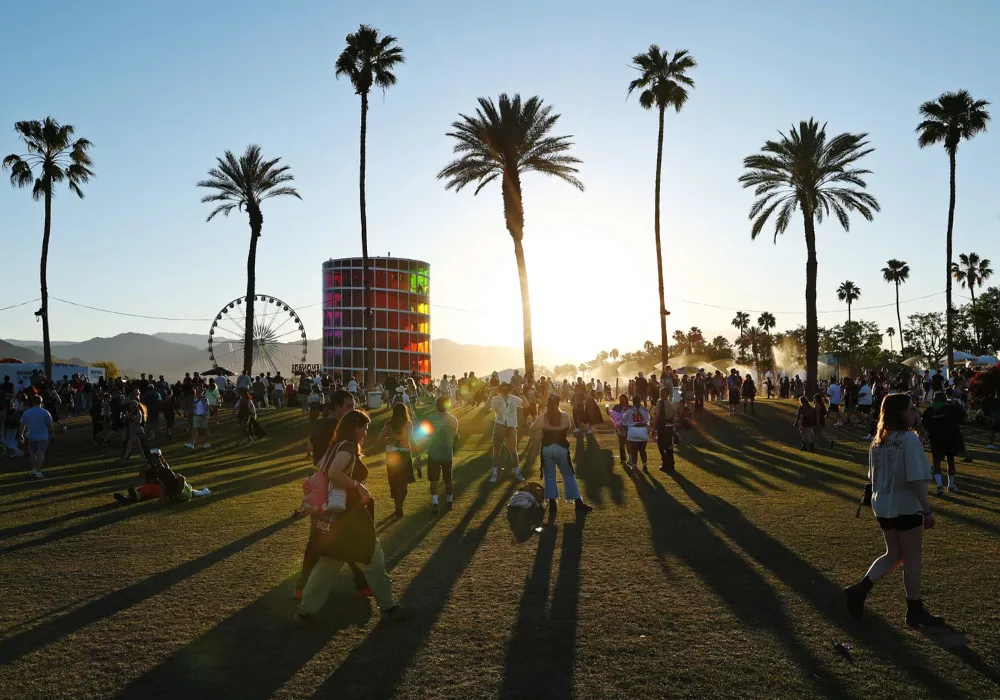

There was a time when Coachella meant something different. When Paul Tollett first brought the festival to the Empire Polo Club in Indio, California in 1999, it was conceived as an antidote – affordable, music-first, and far removed from corporate excess at large-scale events. Free parking, reasonably priced tickets, a crowd that showed up because they actually cared about the bands. Critics at the time called it a corrective to the dysfunction and commercialism associated with Woodstock ’99. It was, in the truest sense, a festival for music lovers.
Fast forward to 2026, and the contrast is almost difficult to process. General admission tickets this year started at USD$649 at face value – even before they sold out, after which point resale prices on StubHub climbed past USD$2,000. A single-day ticket on the secondary market hovers around USD$700, before you factor in flights, accommodations, and on-site prices that see a simple iced latte running at USD$12. And for those wanting the full experience, a four-night VIP yurt package for two comes in at USD$33,000 – with festival passes, at least, included.
The question of whether Coachella is ‘worth it’ has gradually evolved into something more uncomfortable than a simple cost-benefit analysis. It is no longer just a question of money – it’s a question of what we’re actually paying for, and whether the thing we are buying even exists.
Read More: The Best Music Festivals In 2026 That Deserve A Spot On Your Bucket List

What Happens When Everyone Is There To Be Seen
To understand what Coachella has now become, you first have to understand what happened when influencer culture and festival culture converged. Brands quickly identified Coachella as the perfect vehicle – a captive, aspirational, visually rich environment where their products could be showcased to millions of followers through the lens of someone those followers already trusted. Younger audiences, research suggests, are especially responsive to creator-led recommendations, and Coachella’s organisers understood that earlier than most.
What emerged is that a significant portion of Coachella’s attendees are now there, in some sense, to work. Sponsored outfits, brand activations, highly produced content – the festival has become, for a certain class of attendee, a content production event that happens to have live music playing in the background. This creates a strange and increasingly visible tension on the ground. On one side, you have people who have saved for months, used payment plans to spread out the cost of admission, and travelled long distances for the music. On the other, you have influencers and celebrities whose attendance is, effectively, a business expense – whose content then continues to fuel the aspirational myth that drives the next wave of ticket sales.
Emma Chamberlain – herself one of the most successful influencers of her generation – documented this dissonance with unusual candour back in 2018. She described the real Coachella as falling far short of its online representation, noting that the version people post about bears little resemblance to the sweaty, logistically chaotic, often underwhelming reality. And yet she kept going back. Because in the attention economy, being absent from the most talked-about event of the year carries its own cost.

The Myth We Keep Buying Into
This is where the conversation gets philosophically interesting. Coachella, as it exists online, functions as what cultural theorist Roland Barthes describes as a modern myth – a mediated construction that presents itself as natural truth. The glossy Instagram grids, the effortless festival outfits, the implication that everyone there is having the time of their lives – these are not lies exactly, but they are not the full picture either. They are a polished half-truth, and we consume them willingly because the myth is more appealing than the reality.
What’s especially telling is that this myth is not sustained by the festival alone. It is sustained by all of us – by the people who post, by the people who watch, and by the people who buy tickets partly because they have watched. The festival’s cultural power feeds on our collective participation in the fiction. And the price keeps climbing simply because the demand never softens – not because the experience is getting better, but because the cultural cachet of having been there remains undiminished.

Is Coachella Worth It In 2026?
The honest answer is: it depends entirely on who you are, and what you are actually going for.
If you are going primarily for the music – if there are artists in that year’s lineup you truly cannot see anywhere else, in a setting that means something to you – then the experience can still hold up. Justin Bieber’s Coachella set this year is a case in point. It was raw, unconventional, and moving in ways that no stadium tour could have replicated. Those moments are real.
But if you are going because Coachella feels like something you are supposed to do – because the feeds made it look unmissable, because you want to be in the photos, because FOMO has overridden your better financial judgement – then it is worth pausing. You are not simply buying a ticket. You are buying into a myth that has been so effectively constructed that it keeps you buying in.
The festival that once prided itself on accessibility is now, structurally, a tiered experience where the quality of your weekend scales almost directly according to your spending power. The gap between what a USD$700 single-day ticket holder experiences and what someone in a USD$33,000 yurt experiences is not incidental – it is built into the model. And the influencer content that dominates our feeds almost exclusively reflects the latter experience, creating a wildly distorted picture of what most people’s Coachella actually looks like.
None of this means that Coachella has lost all value. It means we should be clearer-eyed about what we are valuing. The live music can still be transcendent. The community can still be electric. But the myth – the idea of Coachella as a democratic, magical, accessible paradise – is exactly that. A myth. And at USD$2,000 a resale ticket, it is one of the more expensive ones we have all agreed to keep believing.

Catherine Pun
A Hong Kong native with Filipino-Chinese roots, Catherine infuses every part of her life with zest, whether she’s belting out karaoke tunes or exploring off-the-beaten-path destinations. Her downtime often includes unwinding with Netflix and indulging in a 10-step skincare routine. As the Editorial Director of Friday Club., Catherine brings her wealth of experience from major publishing houses, where she refined her craft and even authored a book. Her sharp editorial insight makes her a dynamic force, always on the lookout for the next compelling narrative.