

After nearly two decades on screen, Mario Maurer remains one of Thailand’s most prominent actors. Yet, between a loyal regional following and a hunger for roles he has never played, he seems less invested in preserving his image than in discovering what else he might become.
Mario Maurer does not enter a room like someone who has spent most of his life being recognised. At Mondrian Hong Kong, where we meet him for his cover shoot, the Thai actor is relaxed, soft-spoken and faintly amused by the organised chaos of a production day. Cameras are adjusted, questions tweaked, lights checked – yet Maurer carries himself with a composure that feels almost resistant to the machinery of celebrity.
Read More: Toey Jarinporn Joonkiat Moves At Her Own Pace

Watch: Longines
Bracelet: Luxnara
That calm is deceptive. Maurer occupies a rare space in Asian entertainment: mainstream heartthrob, box-office lead, cross-border star, devoted fan favourite and lasting box-office draw. He first broke through with The Love of Siam in 2007, a film that introduced him to audiences across the region. A few years later came Crazy Little Thing Called Love, the sleeper hit that turned him into a romantic ideal for a generation of Southeast Asian viewers. Then came Pee Mak, the 2013 supernatural romantic comedy that became a milestone in Thai cinema and sealed his status as one of the country’s most bankable leading men.
For an actor with that kind of history, the danger is not being forgotten. It is being remembered only for what he has already done – typecast, boxed in, reduced to a single version of himself. A familiar face, a recurring name, loyal fans who continue to show up – from the outside, longevity can look like repetition. To Maurer, however, staying visible does not mean staying the same.
‘I’m not really picky,’ he says, when asked whether he has become more selective after such a long career. ‘But I consider the role. When I read a character and I believe in it, I want to deliver that role – I look for something that challenges me and something that really interests me.’
It is a simple answer, but it reveals how Maurer has navigated the cycles of fame. He does not speak about strategy, positioning or pivoting in the usual scripted language of celebrity; he speaks about belief – the character must feel real to him, the work must consume him, the challenge must be concrete.
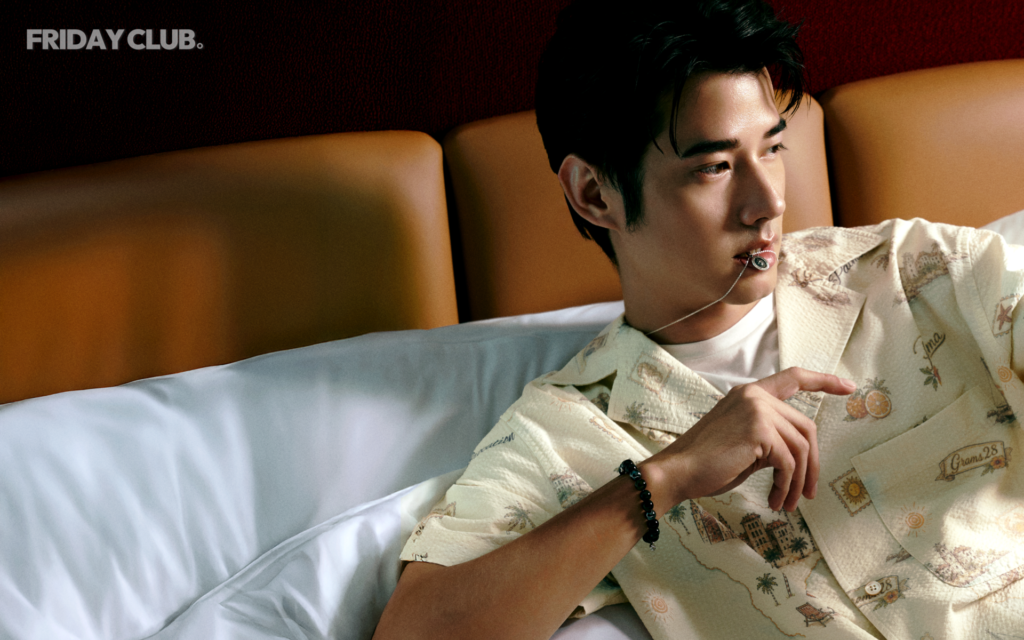
Bracelet: Luxnara
Necklace: REALM
For an actor so closely associated with romance, boyish charm and effortless screen appeal, Maurer now seems drawn to parts that push him beyond the types he’s known for. ‘For me, now, it has to be something I’ve never done before,’ he says. ‘Acting has so much variety – there are still so many more things I can go for: something out of the box, something unusual. I’ve never played a police officer or an investigator – something like that.’
There is a slight spark when he says this, as though unfamiliarity still has the power to ignite something in him. After all these years, the question is no longer whether Mario Maurer can carry a film, command a camera or hold an audience’s attention – he has already done all of that. The more interesting question is what happens when an actor known for being loved decides he would rather be challenged.
That appetite for growth arrives at a telling moment. In recent years, Maurer’s work has continued to span genres and formats – from horror and action to comedy and streaming-era projects. AI Love You reunited him with Baifern Pimchanok for a new generation of viewers, while Khun Pan 3, 4 Tigers, Food Truck: Stolen Love and Moo Deng have kept him busy across different corners of Thai cinema. His recent trajectory suggests an actor who is not simply returning to familiar territory, but actively seeking to expand it.
Still, he is realistic about what it takes to remain relevant. Asked whether success becomes easier with age, Maurer pauses. ‘I think it’s harder to maintain,’ he says. ‘You are getting older, but you still have to stay updated. You have to follow how the world moves, and you have to go with it.’

Jewellery: Kevlin.club
For many actors who began their careers before the full dominance of social media, that shift can be unforgiving. Fame used to be measured in cinema queues, television ratings and fan meetings. Now, it operates through algorithms, short-form clips, brand metrics and the endless demand to be both accessible and aspirational. Maurer is among a generation of stars who had to grow up twice: first in public, then online.
His answer to that pressure is not to become louder. It is to go deeper into the work.
‘Every time I do a new film or series, I have to really study the character,’ he says. ‘I have to know what he likes, what he does, how he grew up. Nowadays, I have to be even more creative. When I go into a character, I have to put in more input.’
That word – input – feels important. Maurer does not approach acting as complete metamorphosis; instead, he describes it as layering – details, habits, background, curiosity – the gradual building of a life that is not his own until, eventually, he can make it feel believable.
Perhaps that is why, even after years of being treated as a star, Maurer remains down-to-earth. He does not self-mythologise, nor does he frame his career as a conquest or his fame as proof of greatness. Instead, he circles back again and again to people: his team, his fans, the crews he works with, the strangers who stop him on the street.

Pants: Paul Smith
Watch: Longines
Suitcase: Departure





Catherine Pun
A Hong Kong native with Filipino-Chinese roots, Catherine infuses every part of her life with zest, whether she’s belting out karaoke tunes or exploring off-the-beaten-path destinations. Her downtime often includes unwinding with Netflix and indulging in a 10-step skincare routine. As the Editorial Director of Friday Club., Catherine brings her wealth of experience from major publishing houses, where she refined her craft and even authored a book. Her sharp editorial insight makes her a dynamic force, always on the lookout for the next compelling narrative.