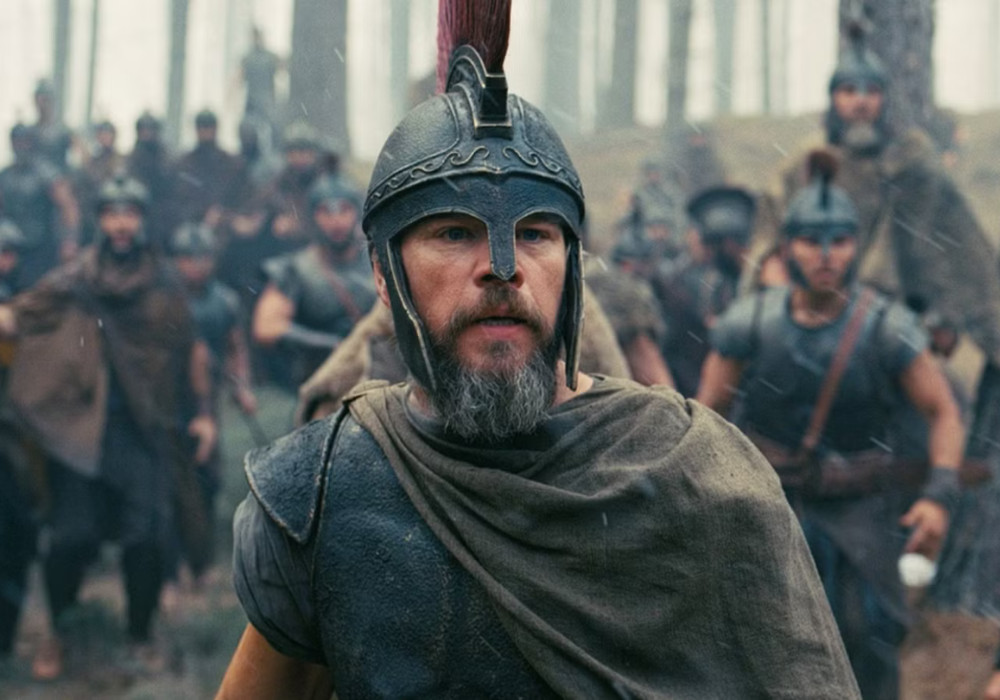

Spoiler Warning: This piece discusses major plot points from ‘The Odyssey’
Christopher Nolan’s ‘The Odyssey’ arrives at a moment when his own legend as a filmmaker already feels near-mythic. This is a director whose name alone still sends people to the cinema – and here he doubles down on that commitment to the big screen by becoming the first to shoot an entire feature on IMAX film.
What unfolds is a rousing, visceral vision of Homer’s epic – not so much a faithful adaptation as Nolan’s own song about the man called Odysseus, clawing his way back home.
Read More: Review – The Evil Lawyer – It Feels Uncomfortably Familiar
An Epic Poem Told Through IMAX
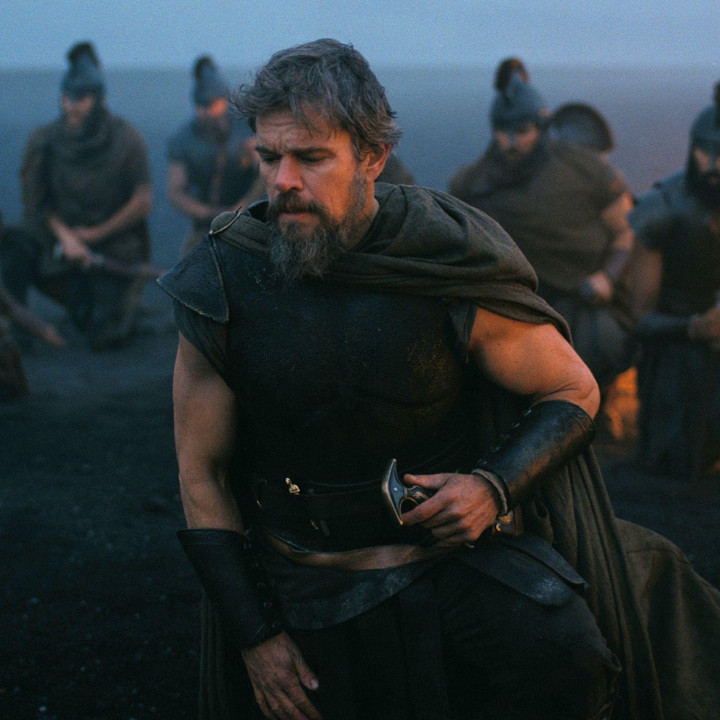
It’s safe to say Nolan has been working his way towards this for years – each film since his earliest IMAX experiments pushing further into what the format can do. Here, he finally goes all in: ‘The Odyssey’ is a wall-to-wall IMAX experience, epic not just in scale but in tactility. You feel the spray of Poseidon’s wrath, the grit of Ithaca’s dust, the claustrophobia of cramped decks and cramped consciences.
Much has already been typed across the internet about how Nolan’s cinematic endeavour fits into conversations around accessibility in today’s movie-theatre landscape. Here’s just one opinion: a standard 35mm showing may crop some of the fuller IMAX scenes, but the viewer loses nothing essential – the film remains an immersive, tactile cinematic experience.
Within those colossal IMAX film reels, Nolan charges into his vision without apologies. Rather than chasing museum-grade historical accuracy – a slippery concept already for a story with a cyclops, sirens, and giants – Nolan embraces the idea that this is his telling alone: a cinematic bard’s version of events.
The opening title card, ‘In a time of apparent magic…’ giving way to Travis Scott’s poet reciting the song of the Trojan Horse, and the closing scene, with Odysseus’ hushed reflection that only songs will remain of what we’ve just witnessed, bookend the film as one long act of remembrance. Time and place may be ancient Greece, but the film feels untethered from any fixed century or land mass. It belongs to the realm of stories we keep retelling until they become truer than history.
The epic poem itself has always been passed through oral traditions, with each translation arguably becoming an almost new tale. In that light, Nolan’s rendition shouldn’t be hard to digest. Set against the centuries-old fabric of ‘The Odyssey,’ Nolan is adding his own song to the myth – no more official than the many versions told before him.
A Cast Of Mortals & Monsters
On paper, Nolan’s casting choices raised a few eyebrows. With a film this star-studded, there’s always the risk that you’re just watching famous people in cosplay rather than anyone truly disappearing into a role. On screen, that fear is largely sidestepped where it matters most.
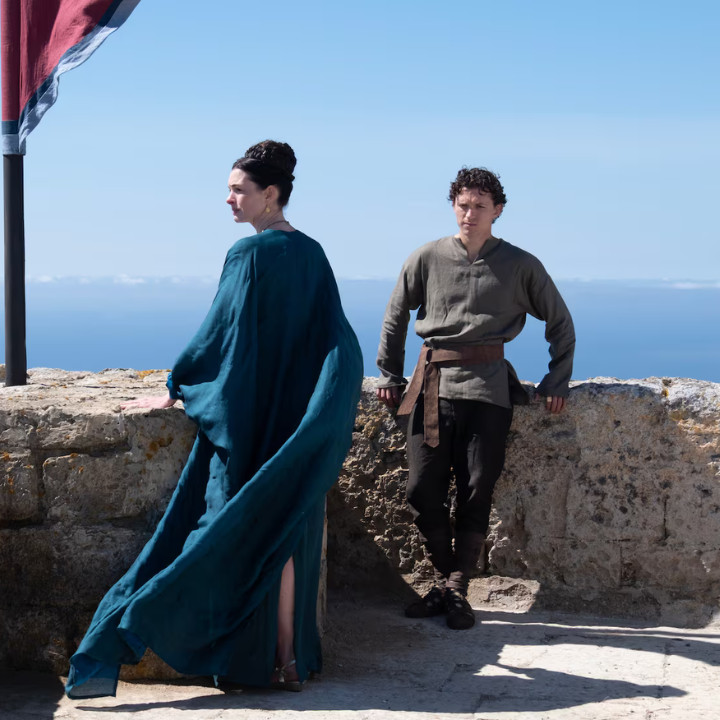
Matt Damon gives an emotionally raw, fiercely embodied Odysseus – every year of the voyage etched into his body – letting you feel the shifts in him as strategist, sinner, and shattered man. Anne Hathaway refuses to let Penelope be reduced to the stock ‘wife left behind,’ playing her instead as a keen, watchful woman juggling grief, duty, and a slow-burning rage held just beneath the surface.
As their son Telemachus, Tom Holland delivers a capable performance as an unsure, untested young man figuring out his path, though he does look out of his depth at critical moments opposite Hathaway and Damon – giving him dialogue littered with ‘Mom’ and ‘Dad’ certainly doesn’t help.
Himesh Patel’s Eurylochus is a steady presence as Odysseus’ second-in-command, treading a fine line between occasional voice of reason and just another flawed, exhausted man caught between war and gods. Samantha Morton, on the other hand, runs away with the film’s most magnetic role as Circe – a part that could easily have been tossed aside or turned into an overcooked caricature in less capable hands. Instead, she gives ‘The Odyssey’ some of its most terrifying moments, bringing an eerie physicality that stays with you long after she leaves the screen.
That’s not to say the rest of the ensemble falls neatly into convincing or unconvincing – it’s more of a mixed bag. Jon Bernthal’s Menelaus spends too many moments feeling like Bernthal playing himself, or another shade of The Punisher. But Robert Pattinson – a leading man by any measure in today’s Hollywood – sinks his teeth into the cruel, cowardly suitor Antinous with such snivelling callousness you can practically feel the slime oozing off the screen.
The Horror Beneath The Myth
What makes ‘The Odyssey’ so unnerving is the film’s commitment to rooting its most mystical episodes in horrifying, physical detail, with Nolan pushing deep into body horror and practical effects.
The transformation of Odysseus’ men into pigs isn’t performed in a swirl of CGI haze. It’s a visceral nightmare – Circe literally moulding and yanking faces into snouts under the unflinching gaze of the camera. Creatures like the cyclops Polyphemus and the giant Laestrygonians are rendered with the same brutal realism, designed to feel like they exist in the same grimy, sweat-slick world as the humans they terrorise.
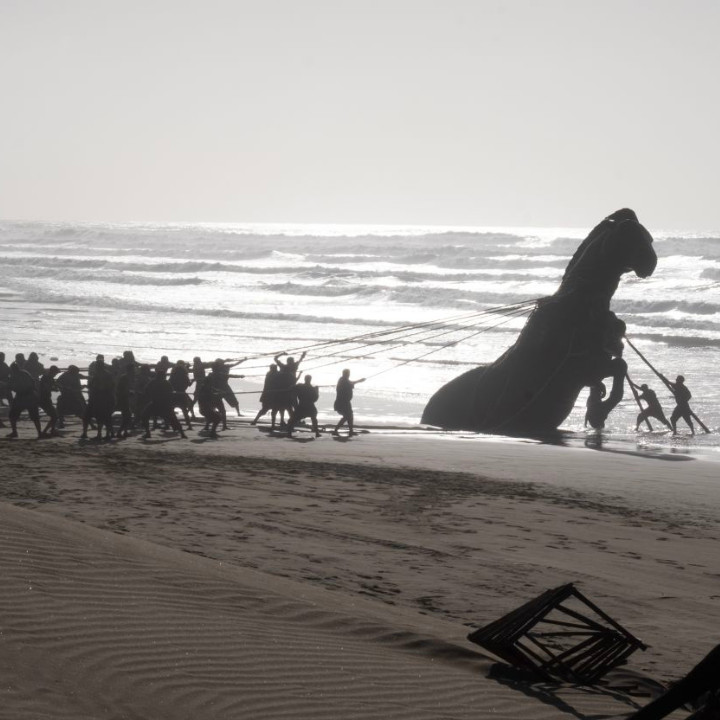
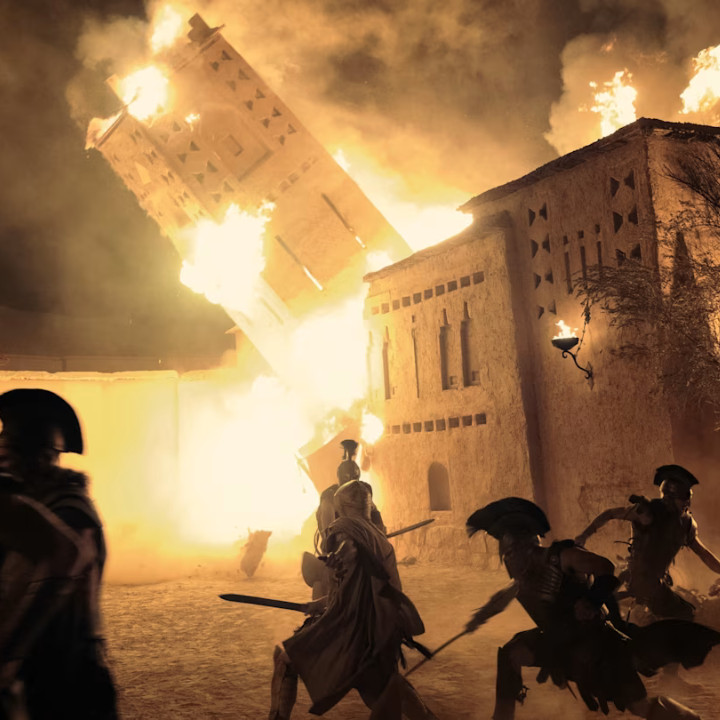
Yet for all the talk of gods and monsters, one of the film’s most staggering set pieces is purely human – told through Menelaus’ retelling of the Trojan Horse coup from inside the belly of the beast.
Gone is the tidy image of soldiers lined up in armour inside a primitive wooden horse, wheeled calmly into Troy. Instead, Nolan turns the fabled horse into a massive, sinewy prison: a heaving wooden carcass crudely packed with men piled atop one another in filth for days – some dying before they ever make it into battle – while outside, the people of Troy strain to drag this ‘gift’ across logs, inch by agonising inch.
It’s a brutal retelling of a myth we think we know, and it instantly justifies Nolan’s decision to depict the consequential battle that the original poem only ever alludes to. But the true nature of this notorious siege reveals itself slowly, in what becomes the film’s clearest thematic echo of Nolan’s ‘Oppenheimer.’
Another brilliant man engineers a novel, decisive victory – and is left haunted, largely in the form of Zendaya’s Athena, by the devastation he has unleashed upon civilisation. The act of cramming into a deceptive wooden behemoth to bring total desecration upon an unsuspecting city transforms from the story’s ultimate triumph into its original sin.
Zeus’ law – that guests and hosts must exhibit mutual respect and hospitality, for any stranger may be a god in disguise – hangs over ‘The Odyssey’ like a radiation cloud. It’s the breaking of this law that calls down the wrath of both gods and monsters, this shattered commandment marking every corpse and every wave that follows Odysseus and his soldiers on the long road home.
When Victory Corrupts A Civilisation
In the climactic bloodbath of ‘The Odyssey,’ the slaughter of the suitors plays out as a tight, relentless action sequence mostly contained in a single room. It’s thrilling in the moment – frenetic, tense, superbly choreographed – but ends up feeling slightly overshadowed by the true emotional apex of the film that precedes it.
When Odysseus, still in disguise, recounts the fall of Troy to Penelope, he dismantles the heroic songs poets have spun from that night – describing instead a brutal act of vengeance 10 years in the making, where men abandoned Zeus’ law in favour of pure destruction. The film cuts back to those images with clarity and momentum thanks to masterful editing that takes the non-linear structure and braids it together wonderfully.
Through a physical partition, Odysseus and Penelope trade truths that cut deeper than any blade. Penelope’s dawning realisation — that the ‘people from the sea,’ the unidentified enemy force Ithaca fears is coming for them, was born from that pivotal night in Troy – is the film’s most devastating turn.
Whether or not Odysseus and his fellow soldiers are literally those invaders almost doesn’t matter. What does is the understanding that the true terror isn’t some faceless ‘other’ that spits on their most sacred laws, but your own people, carrying the consequences of their sins back through every port they touch, corrupting the civilisation they’re fighting to return to.
In spite of this shattering revelation and the blood-soaked final showdown, a hopeful note closes the film: Penelope reassuring Odysseus, as they head West to honour the dead in exile, that civilisation will rise again. In the end, ‘The Odyssey’ isn’t about getting home – it’s about whether you deserve to, and whether the world you return to can bear the weight of what you did to get there.

Born in Korea and raised in Hong Kong, Min Ji has combined her degree in anthropology and creative writing with her passion for going on unsolicited tangents as an editor at Friday Club. In between watching an endless amount of movies, she enjoys trying new cocktails and pastas while occasionally snapping a few pictures.