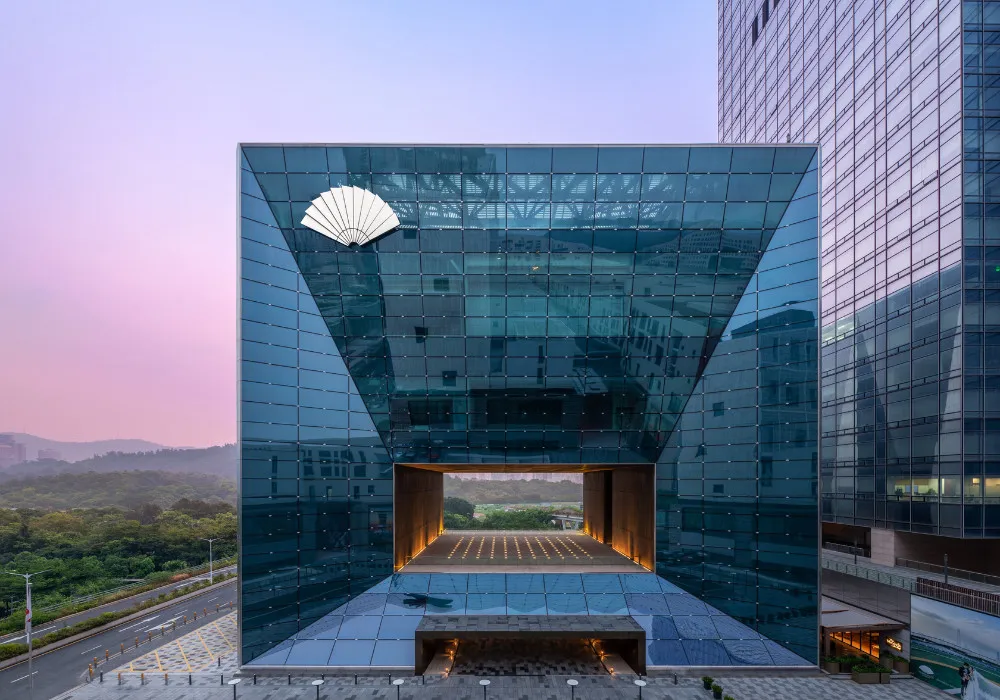

Shenzhen is not a city known for standing still. It moves quickly, builds higher and rarely lowers in volume. Yet 79 floors above Futian, Mandarin Oriental Shenzhen finds something hard-won in this city: stillness.
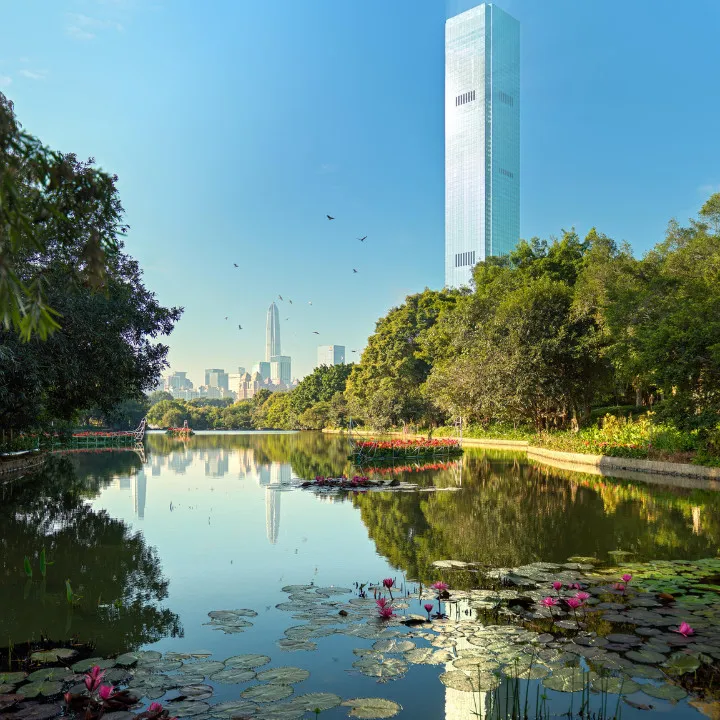
The hotel occupies the upper levels of Tower One at UpperHills, rising above the central business district with views that stretch across Lotus Hill Park, Bijia Mountain Park, Shenzhen Bay and, on a clear day, the distant mountains of Hong Kong. It places you close to the commercial beat of Shenzhen while creating enough physical distance to make the streets below feel worlds away.
That contrast is what makes the location work so well. UpperHills provides shops, restaurants and convenient access to Futian, but the moment the lift begins its climb, the noise recedes. The traffic disappears, the skyline opens up and Shenzhen starts to look less overwhelming.
Read More: Where To Shop In Shenzhen – Sprawling Malls, Hidden Finds & Bargain Deals
A Chinese Identity That Never Feels Forced
Many international luxury hotels in China fall into one of two traps. Some could be located anywhere in the world, while others fill every available corner with obvious cultural references. Mandarin Oriental, Shenzhen takes a more nuanced route.
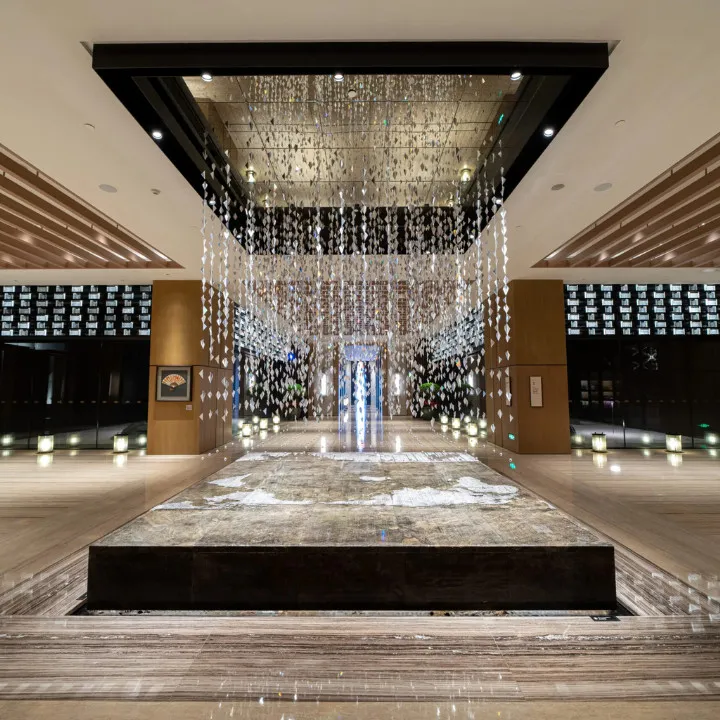
The hotel’s central design theme draws inspiration from salt crystals, referencing Guangdong’s history as an important salt-producing region. In the arrival lobby, an installation by Takahiro Matsuo uses 3,400 prism elements to scatter light through the space, while stone works by Chinese artist Shen Lieyi introduce its theme before guests even reach reception.
These references continue without becoming repetitive. Grey stone walls and warm earth tones recall Shenzhen’s past as a small village, well before it became the glass-and-steel metropolis we know today. The Oriental Suite takes the connection further through furnishings created with Chinese lifestyle house SHANG XIA.
What I appreciated most was the subtlety. The hotel doesn’t rely on dragons, lacquered red surfaces or oversized decorative gestures to announce where you are. Instead, Chinese history surfaces through materials, artwork, calligraphy and well-chosen stories.
Rooms That Put The City In Perspective
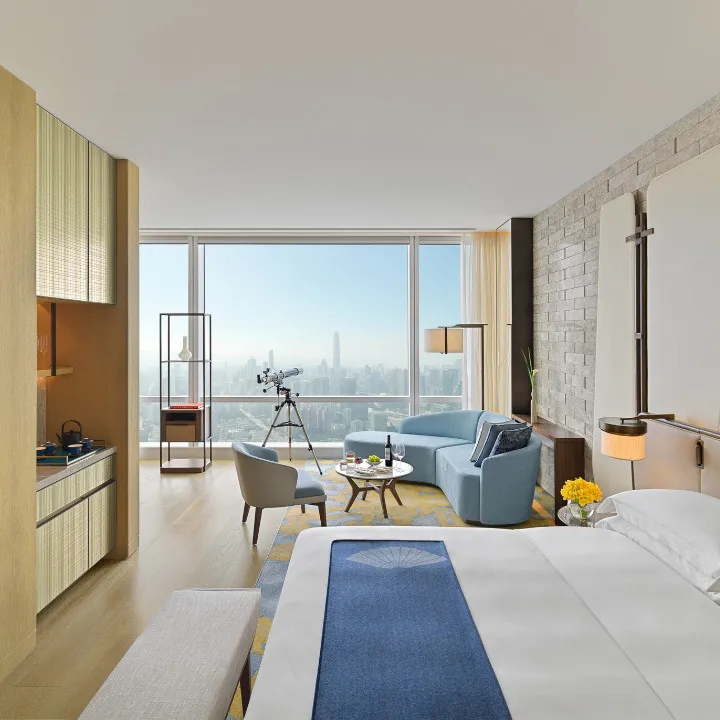
The hotel has 178 rooms and suites, beginning at a generous 56 square metres. Floor-to-ceiling windows do most of the talking, framing skyscrapers, green parks, Shenzhen Bay and the city’s nightly light show. The suites range from 114 square metres to a 400-square-metre Presidential Suite, with several offering bathtubs positioned beside the windows.
Rooms follow a muted palette of beige, grey and warm neutral tones, with abstract carpets and low lighting lending a cocooning feel. Marble bathrooms, walk-in rain showers, Amouage bath amenities, Dyson hairdryers, Bose speakers and pillow menus cover the practical side of the stay, while a valet closet allows clothing or deliveries to be collected without anyone entering the room.
These details count, but the view is the real draw.
Watching Shenzhen from this height changes your relationship with the city. Futian’s towers no longer seem imposing, and even the busiest roads become thin trails of light. In the morning, the surrounding parks bring a vivid sweep of green. At night, the skyline provides all the entertainment you need.
This is one of those hotels where closing the curtains feels almost wasteful.
Finding Silence Above Shenzhen
The greatest luxury here may be the quiet.
Despite sitting in one of the city’s busiest districts, the hotel feels entirely detached from the commotion below. The height helps, but so does the interior design. Corridors are hushed, public areas are expansive and the lighting remains soft throughout.
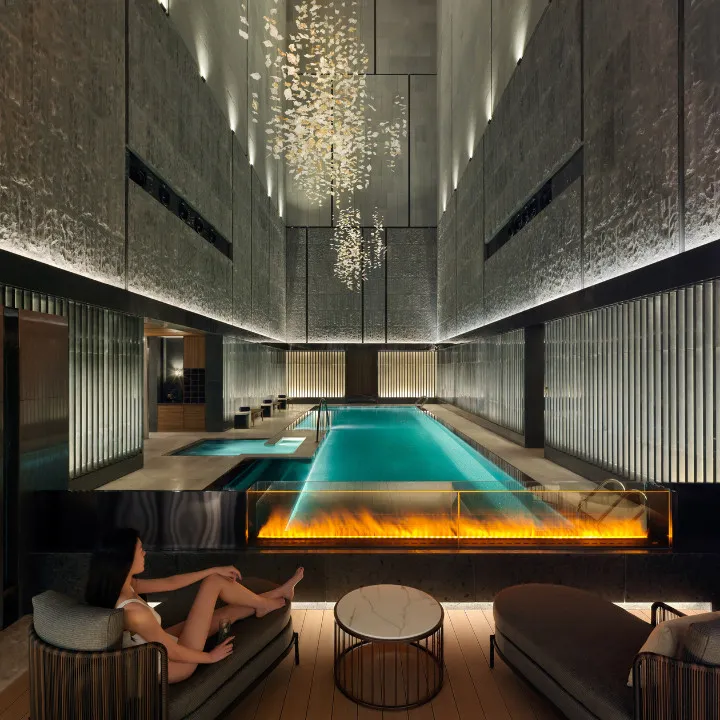
That sense of tranquillity reaches its peak at the spa, where seven treatment rooms are paired with heat and water facilities. Five of the treatment suites look across the city, while reflective artworks inspired by morning dew and cobwebs reinforce the calming mood.
The indoor swimming pool is another draw. At 20 metres long and set under a 30-metre-high, cathedral-like roof, it feels considerably more dramatic than your standard city-hotel pool. Underwater speakers play music below the surface, while the extraordinary ceiling makes the space feel almost monumental in scale.
You could easily spend an afternoon here without feeling the need to return to the city. Swim, visit the spa, order tea and watch Shenzhen continue at full speed beneath you.
Cultural Range Comes Through At The Table
The hotel’s food and drink offering spans Cantonese fine dining, Spanish sharing plates and Chinese-inspired mixology, with each venue speaking for itself.
At The Bay by Chef Fei, Cantonese cooking is presented within a dining room steeped in classical motifs. The restaurant’s Chinese name was written by author and calligrapher Feng Tang, while its private rooms take their names from mountains in ‘The Classic of Mountains and Seas.’ Contemporary works by Chinese artists Chen Xiao Yun and Lu Zhiping keep the space connected to the present.
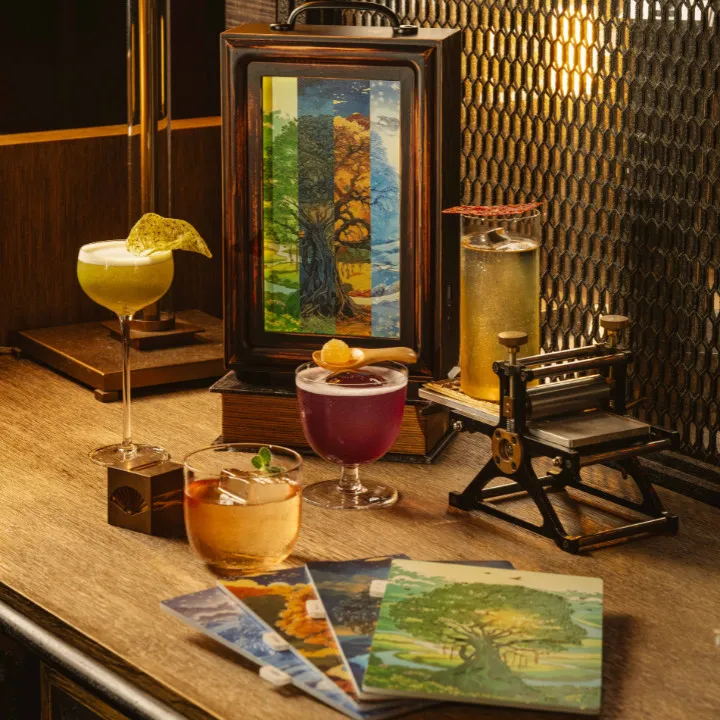
MO Bar takes a different path. Reachable through a timber passage lined with bottle crates and hand-painted signs, the bar resembles an old luxury warehouse. Traditional movable-type printing presses and metal printing blocks appear across the interior, linking the room to China’s history of printing.
Its ‘Colours of China’ menu draws from traditional Chinese colour symbolism, the 24 Solar Terms and ancient printing techniques. Sixteen cocktails and mocktails are arranged across the four seasons, using ingredients including baijiu, Pu’er tea, red dates, green tea and plum. The menu itself features interactive acrylic pages and pull-out colour panels inspired by movable-type printing.
Even with all that cultural context, the experience never feels like a history lesson. You can simply order a drink, step onto the 79th-floor terrace and enjoy the view. Those interested in the stories behind each creation, however, will find much more to explore.
For something lighter, TAPAS 77 serves Spanish sharing plates one floor below. The colourful dining room offers a cheerful contrast to the calmer spaces elsewhere, with dishes including charcoal-grilled Galician octopus, Iberian ham and mushroom croquettes, and paella designed for groups.
Is This Really Shenzhen’s Best Hotel?
Calling any hotel ‘the best’ is subjective. Some guests prioritise nightlife, others prefer resort facilities or direct access to a particular neighbourhood.
Mandarin Oriental, Shenzhen will suit travellers who want privacy, space and a genuine connection to their surroundings without sacrificing convenience. The tower setting may feel slightly removed for those who want to step directly into a traditional street scene, but that separation is a large part of its appeal.
The property is also the first and only hotel in Shenzhen to hold both Forbes Double Five-Star recognition and a Michelin Key. Those awards are impressive, but they’re not the reason I would place it above the city’s other luxury hotels.
What distinguishes it is how cohesive the entire stay feels.
The location gives you Shenzhen without trapping you in its intensity. The rooms provide space and extraordinary views. The spa and pool create true serenity. Most importantly, the art, restaurants and interiors acknowledge Chinese culture with intelligence.
Checkout inevitably means returning to street level, where the city feels louder and faster than you remembered. After spending a night above it all, it takes a moment to adjust.
For me, that is the clearest sign of an exceptional hotel – why Mandarin Oriental, Shenzhen currently earns my vote as the best property in the city.
Mandarin Oriental, Shenzhen, Block A UpperHills, No. 5001 Huanggang Road, Futian District, Shenzhen, China, +86 (755) 8802 6888, www.mandarinoriental.com
Catherine Pun
A Hong Kong native with Filipino-Chinese roots, Catherine infuses every part of her life with zest, whether she’s belting out karaoke tunes or exploring off-the-beaten-path destinations. Her downtime often includes unwinding with Netflix and indulging in a 10-step skincare routine. As the Editorial Director of Friday Club., Catherine brings her wealth of experience from major publishing houses, where she refined her craft and even authored a book. Her sharp editorial insight makes her a dynamic force, always on the lookout for the next compelling narrative.